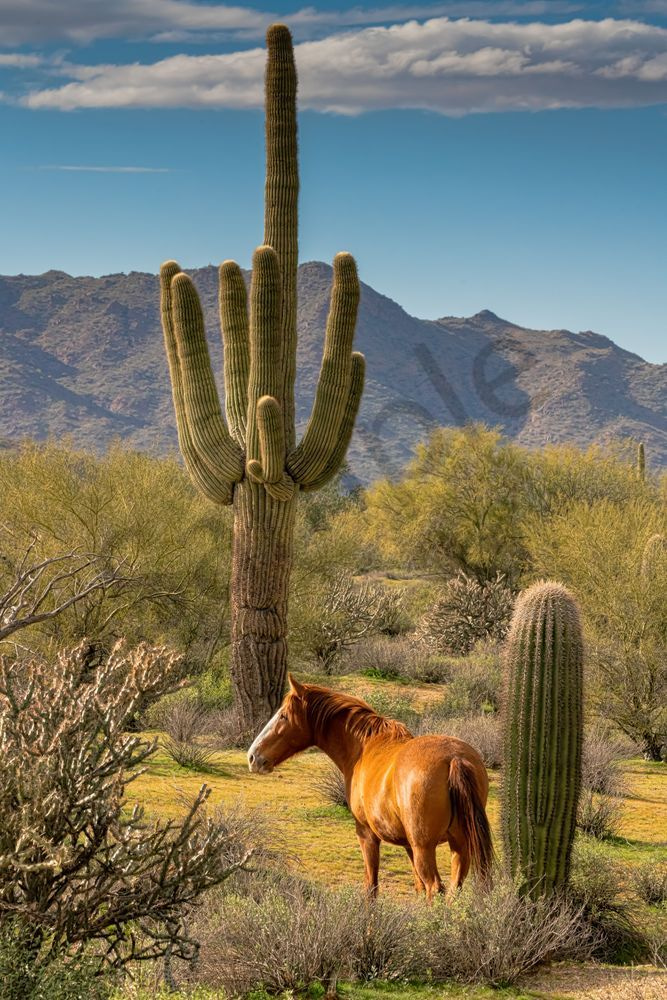
The saguaros behind this stallion are not scenery either: they're a second portrait in the same frame.
A saguaro grows only in the Sonoran Desert and nowhere else on earth. It takes something like a decade to reach an inch tall, may not flower until it's thirty-five, and typically doesn't put out its first arm until somewhere between fifty and seventy-five years old. The multi-armed giants standing behind this horse were very likely here before Arizona was a state. They are protected by law, and moving or destroying one is a serious offence.
So what you're looking at is two long-lived desert residents in one photograph, and the horse is the short-lived one. A wild stallion might see twenty years if he's lucky. The cactus behind him could see two hundred.
That's part of why I keep working this location. The desert gives you a background that doesn't just fill space. It establishes that the animal belongs to a specific place, and only this place. Put the same horse against neutral scrub and you have a picture of a horse. Put him against saguaros and you have a picture of the Sonoran Desert that happens to contain a horse.
On printing this one: the file will go beyond six feet tall, and this is the image I would actually spend that on. The vertical format and the saguaro columns are built for a tall, narrow wall: a stairway, a double-height entry. Most images look merely bigger at that size; compositions with strong verticals look intended.