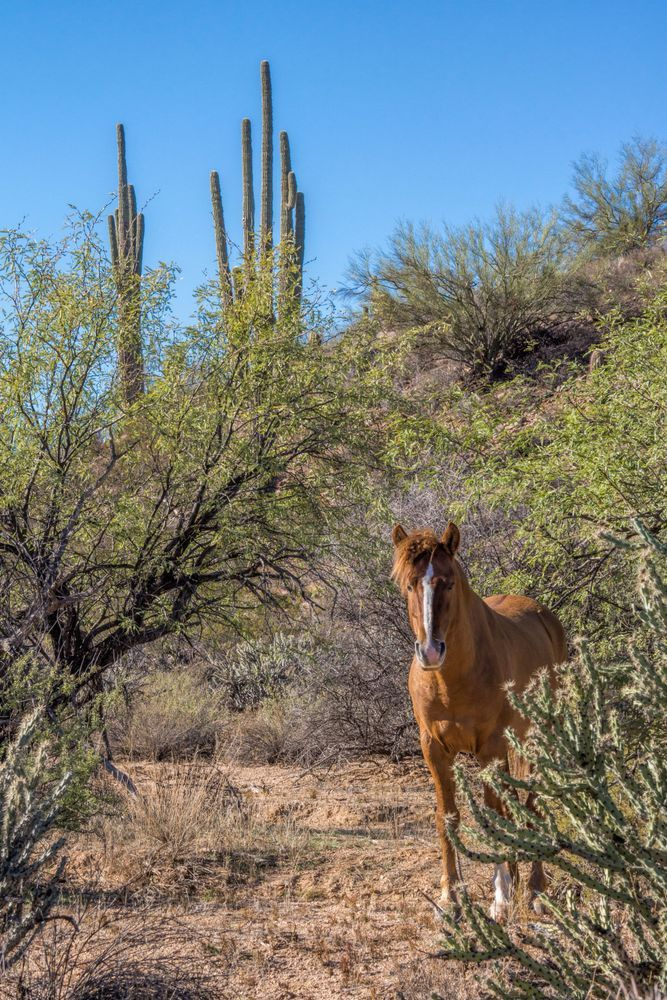
Little Bob was not posing. That's the thing worth knowing about this photograph.
The band stallion is in charge, and anyone who has watched one for an afternoon can see it. He calls the band together. He decides when they move and sends them across the river or the road ahead of him, then follows behind the last horse so that nothing is left unwatched. Leading from the back is still leading. When one stands still and faces you for twenty minutes, he is not being photogenic. He is assessing you, and he has positioned himself so that you have to get past him.
Knowing that changes how the picture reads. The stillness isn't calm, it's evaluation. The ears, the angle of the head, the squared-up stance: all of it is a stallion deciding whether the thing with the tripod represents a problem, while his mares graze somewhere behind him, out of frame and deliberately so.
Which is also the argument for the long lens. Fifty feet is not a legal requirement, it's a working minimum that keeps the animal's behaviour honest. Get closer and you stop photographing a wild horse and start photographing a wild horse reacting to you.
On printing this one: this is a portrait that needs room around it. The composition already has air on both sides, and cropping in to make the horse bigger would throw away the thing the frame is about. That he's standing between you and something you can't see. Hang it with space around it and don't let it fight a busy wall.