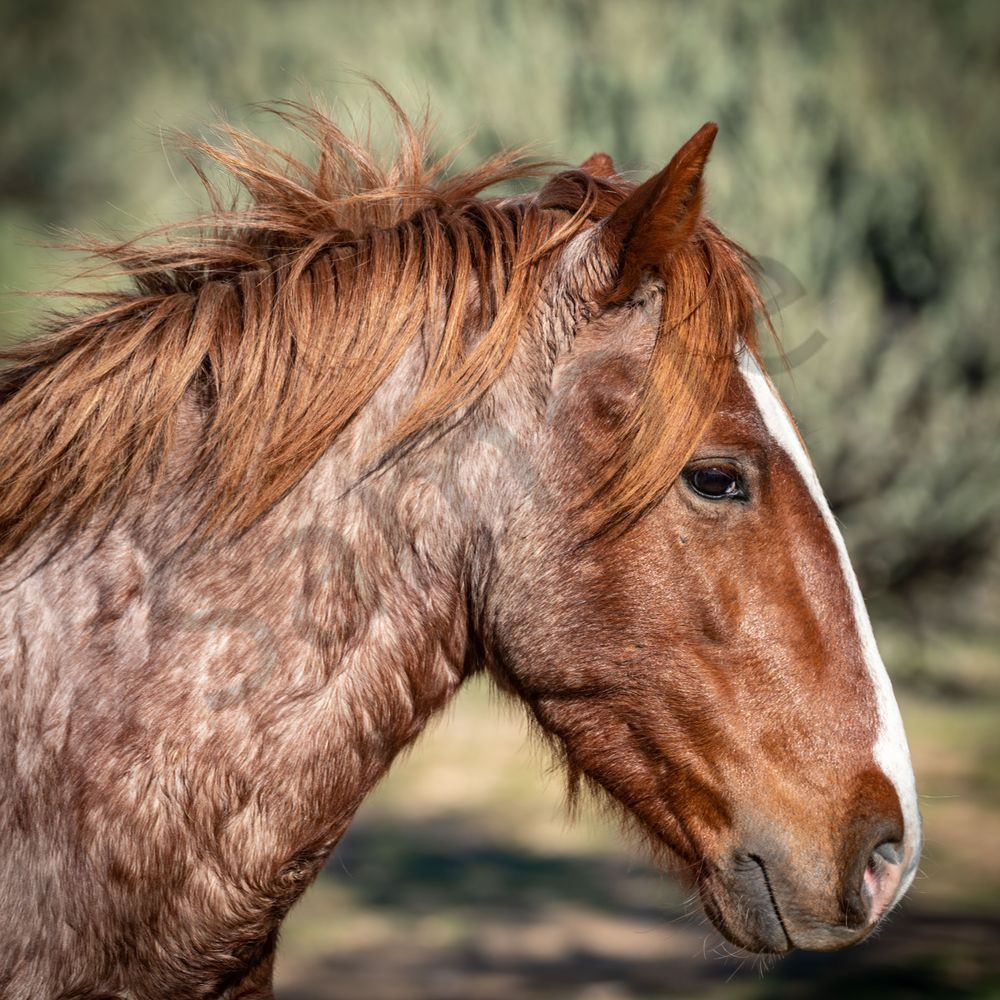
A close portrait raises a question the wider shots don't: what actually is a mustang?
The word covers free-roaming horses of the American West, and it carries an origin story usually told in a straight line back to Spanish colonial horses that escaped or were traded into the Southwest from the sixteenth century onward. Genetic work on several western herds has found Iberian ancestry consistent with that account. But most free-roaming herds also absorbed ranch, cavalry and draft horses over the following centuries, so a mustang is better understood as a population shaped by this landscape than as a preserved breed from any single source.
What that produces is visible at this distance. These are not uniform animals. Colour varies enormously across the herd, bay, black, chestnut, roan, grey, pinto, and so do head shape and build, because the population was never selected toward a standard by anyone. What they have in common is the result of the desert rather than of breeding: hard feet, efficient body condition, and the wariness of an animal that has never depended on people for anything.
Close in, you also see that the face is the most individual thing about a horse. Locals can name dozens of these animals on sight, and once you have photographed the same band across a few seasons, so can you.
On printing this one: a tight portrait is the one image here that survives being small. It works at desk or shelf scale where a landscape wouldn't, and it's the right choice for a grouping: three portraits at matching size and framing make a stronger wall than one enlarged to fill the space.