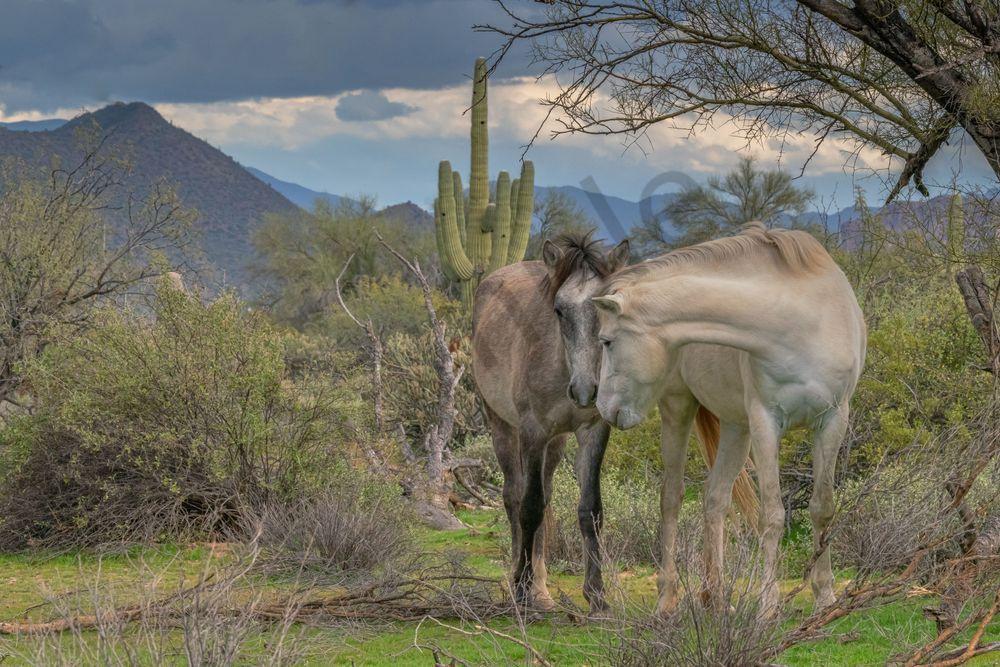
Mutual grooming is the currency of horse society, and what you're seeing is a real relationship rather than a lucky moment of apparent affection.
Horses that groom each other are usually established companions: often the same pair, year after year, within a band. They stand head-to-tail and work along the neck, withers and back, reaching places the other one cannot. It's practical: those are the spots a horse can't scratch alone. But the effect isn't only practical. Grooming at the withers measurably lowers a horse's heart rate, so two horses doing this are genuinely calming each other, and they choose their partners consistently rather than at random.
That's why the anthropomorphic reading of a photograph like this isn't as wrong as it's often assumed to be. The two horses in this frame have a preferential bond. They are not demonstrating affection for the camera and they're not performing anything. They're doing maintenance on a relationship that will still be there next year.
You describe shooting a sequence: one grazing, the other moving up alongside, a moment of contact, then both heads back down. That's exactly the shape of it. These exchanges are brief and unhurried, and the photograph is a fragment of an ordinary afternoon rather than an event.
On printing this one: the picture is built on a shape, the arc two necks make when they meet. That reads instantly at any size, which makes this the most forgiving image here for a small print, and the obvious one for a gift, exactly as your product copy says. It also hangs well as a pair with one of the single portraits.