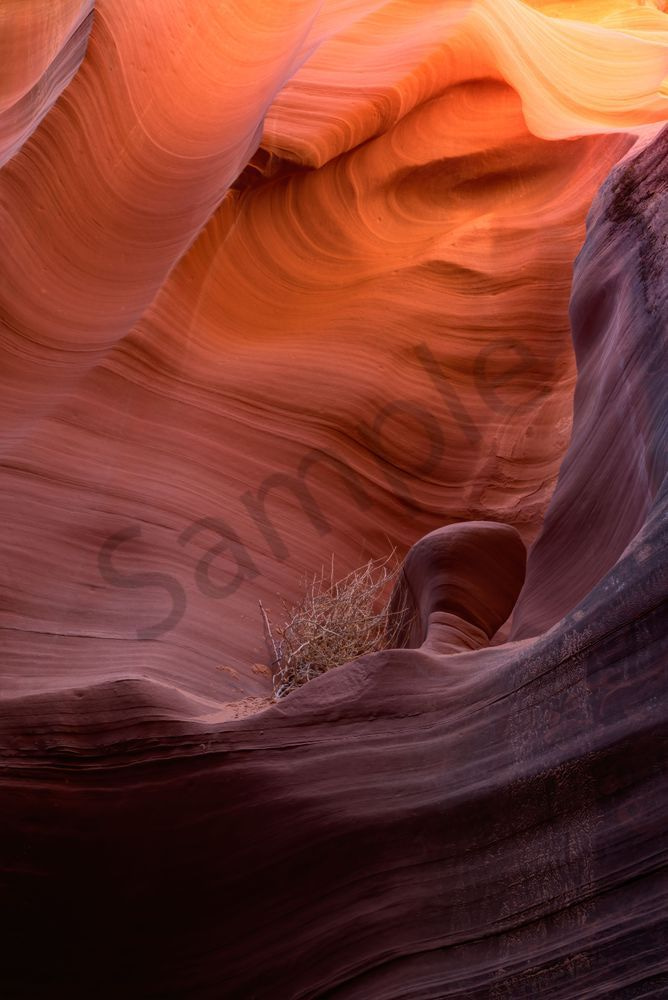
The dry brush at the bottom of this frame is a flood gauge.
Vegetation does not grow on a slot canyon floor. Anything green or woody you find down here arrived as debris, carried in by water and dropped when the flow lost its strength. Where that debris ends up wedged, and how high on the walls you find it jammed into cracks, tells you how deep the water ran the last time this canyon filled.
In many slot canyons you can find driftwood and matted grass ten, twenty, thirty feet above the floor. That is not a curiosity. It is the reason these canyons are dangerous and the reason guided access exists at all: the storm that fills them may be falling twenty miles away under a sky that is perfectly clear where you are standing, and there is nowhere to go sideways.
None of which is visible in the photograph, and that gap is part of why I keep coming back. The canyon at rest is one of the most serene places I have photographed: still air, soft bounced light, no sound, smooth flowing rock. The same passage a few times a year is a pipe full of moving water and sand. The shapes in this frame are a record of the second thing, made while the first thing was true.