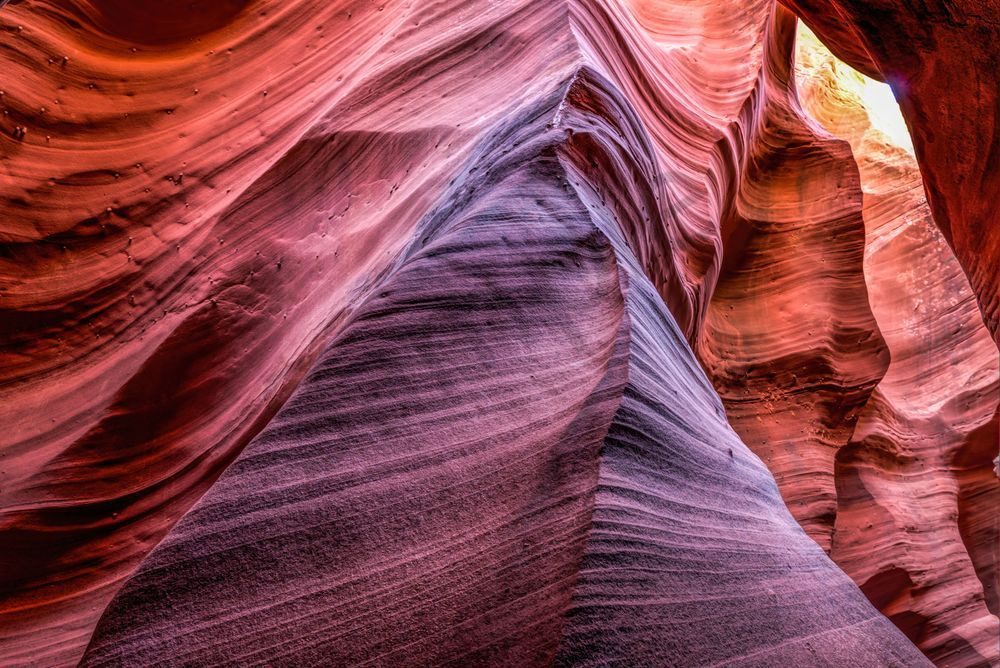
This is the most architectural of the eleven, and the reason is a single wedge of light.
Slot canyon photographs usually organise around a curve. This one organises around a straight edge: a hard-edged triangle of brightness entering at the top right where the opening above runs parallel to the wall, cutting across diagonal bedding that runs the other way. Two straight lines at odds with each other, in a place made almost entirely of curves.
The diagonals themselves are bedding planes, the boundaries between layers of sand laid down at different moments, and they are the reason the wall looks striped rather than uniform. Where the water cut across them at an angle it exposed each layer as a band, and where the layers differ slightly in hardness the softer ones have eroded a fraction deeper, so the stripes are texture as well as colour.
The purple and orange sitting side by side is not a colour grade. Those are two parts of the same wall receiving light that has bounced a different number of times, and the boundary between them is sharp because the geometry above is sharp. Slot canyons produce colour transitions this abrupt regularly, and they are the hardest thing in this whole body of work to convince people is real.