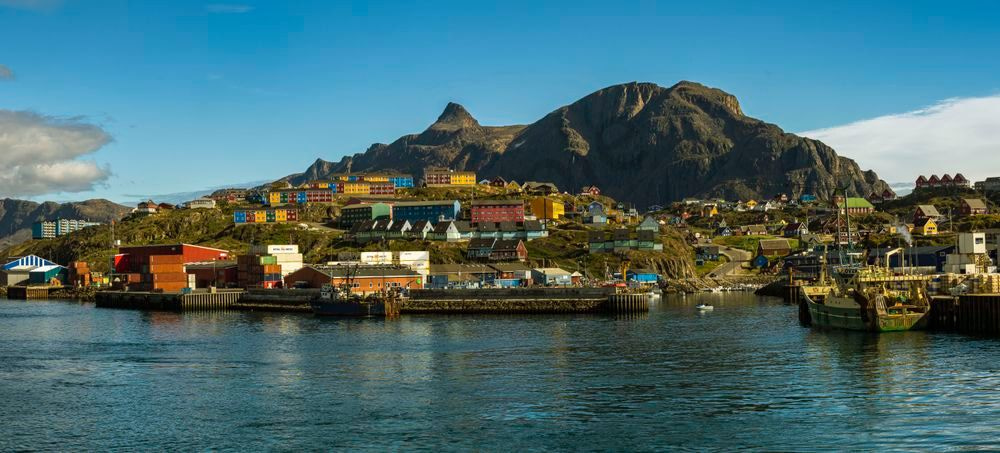
We came alongside in Sisimiut: tied up to the dock and walked off, which after days of wet landings by zodiac felt like an unreasonable luxury. Sisimiut is Greenland's second largest community, around 5,500 people, and it is the northernmost town in the country with a year-round ice-free port. That single fact explains most of what you see in the harbour.
Fishing is the engine, principally shrimp and halibut, and it is the largest private employer in the country. The vessels in this frame are working boats, not pleasure craft, and the industrial buildings behind them are processing plants. Greenland's economy rests heavily on this one sector, which is precisely the vulnerability that makes economic diversification, and by extension, independence, such a difficult question.
The town is not only industry. Sisimiut has one of Greenland's four high schools, an excellent museum, and hosts the Arctic Sound Festival, an international gathering where young musicians and storytellers come together. Our day there included guided town tours with local guides, museum entry, a "Taste of Place" event serving Greenlandic food at the culture centre, and an archaeology walk.
Fun fact: the colours of the buildings are a colonial-era administrative system, not a folk tradition. Denmark assigned colours by function, red for churches, schools and shops, yellow for hospitals, green for telecommunications, black for police, blue for fish factories, so that a settlement could be navigated before it had street names.
On printing this one: the painted buildings are saturated in a way that surprises people who think of the Arctic as monochrome, and saturation is exactly what metal does best. This is one of the few town images in the gallery where I would not hesitate: go metal and let the colour do its job.