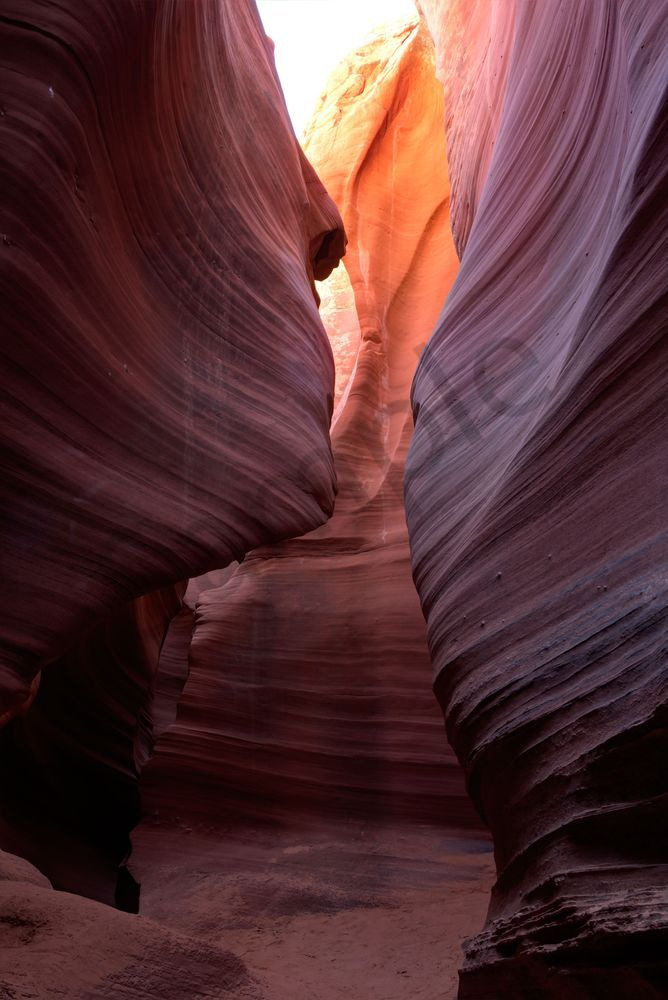
The stripes running through this rock are fossilised sand dunes.
Navajo sandstone was laid down in the early Jurassic, roughly 190 million years ago, when this part of North America sat under one of the largest deserts the planet has known: an erg of wind-driven dunes on the scale of the modern Sahara. Each dune had a steep downwind face, sand avalanched down it, and the resulting layers were buried, compressed and cemented into rock.
Those layers are what you are looking at. The diagonal lines crossing this wall are the preserved slopes of individual dune faces, which is why they run at an angle to each other rather than lying flat, and why the direction they lean records the wind that blew 190 million years ago. Geologists read them as a weather report from the Jurassic.
Then water cut down through the stack and exposed a cross-section of the whole thing. So the canyon has two separate time signatures in the same frame: the horizontal striping made by an ancient desert, and the vertical flowing shape made recently by flash floods running perpendicular to it. That collision of two processes at right angles is what makes slot canyon walls look carved by intention rather than accident.