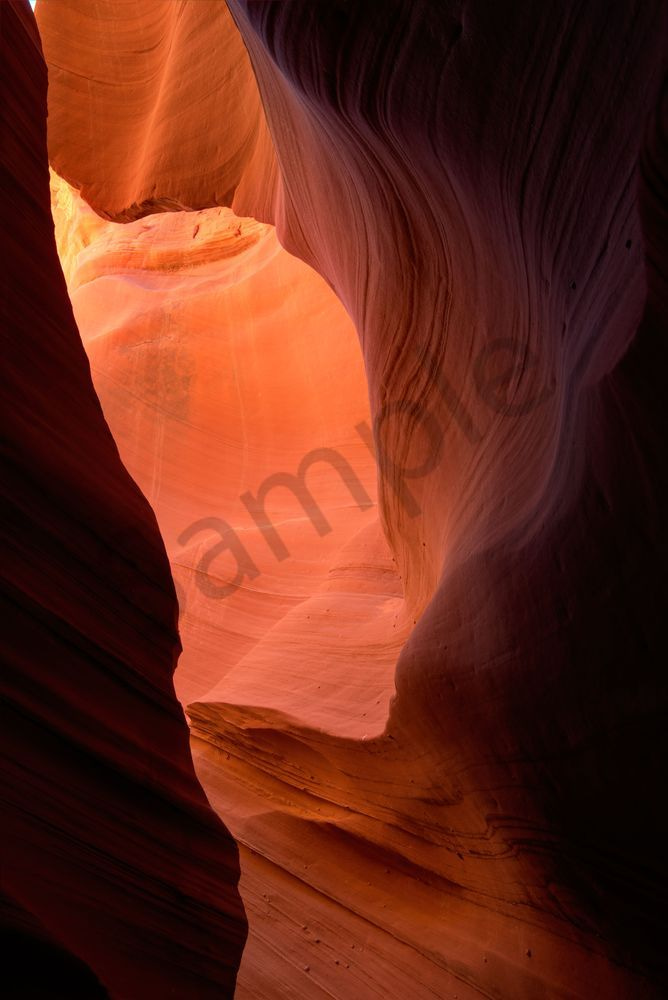
The technical problem in this frame is larger than it looks.
The brightest patch and the darkest corner here are separated by more stops of light than any sensor records in a single exposure. A slot canyon routinely spans a range that the eye handles comfortably and a camera does not, because your eye adjusts continuously as it moves around the scene while a photograph has to commit to one setting for the whole frame.
Expose for the glow and everything around it goes to black with nothing in it. Expose for the walls and the glow blows out to a flat white shape, which is the single most common failure in slot canyon photography and the reason so many of these images have a featureless hole where the interesting part should be.
What I wanted here was the middle: enough detail retained in the bright form that you can still read the grain and the layering inside it, and enough left in the surrounding rock that it is clearly stone rather than a void. The darkness in this frame is meant to be dark. It is not underexposure, it is the actual condition of a canyon floor forty metres below a one-metre opening, and letting it go black is closer to the truth than lifting it would be.