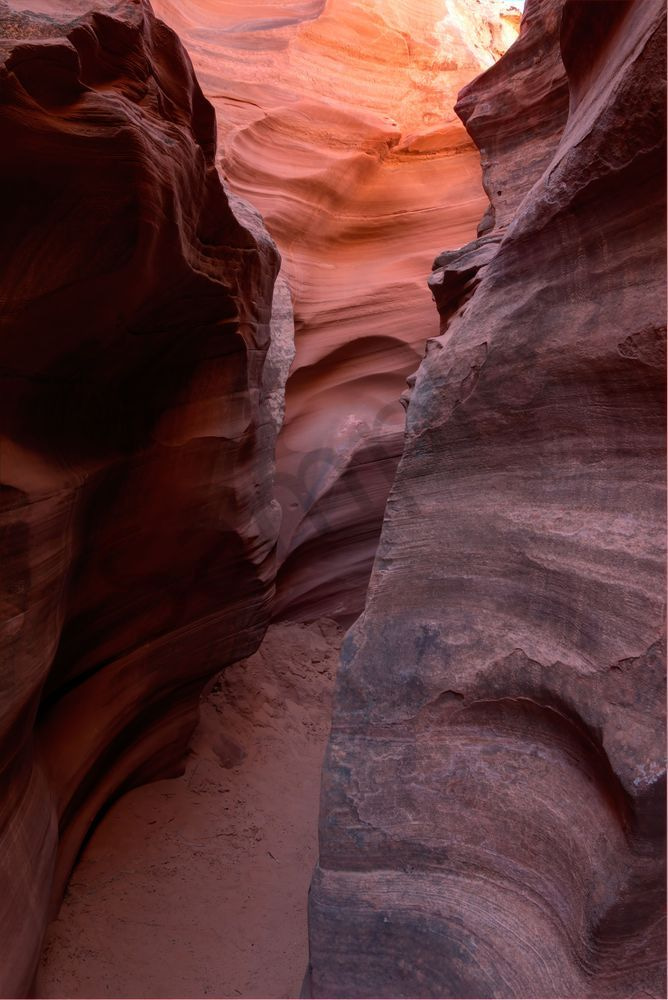
This is the frame that comes closest to what it feels like to walk here.
Most slot canyon photographs are made looking up, which is where the drama is, and which is also why so many of them read as abstractions. Point the camera along the passage instead and the place turns back into somewhere you could go: a floor, a direction, a distance, walls with a near and a far.
The cool foreground and warm middle distance are the give-away about how the light works. Where you are standing, the rock is lit by sky and reads blue. Twenty feet ahead, where the canyon narrows and the walls lean closer together, the light has bounced more and gone gold. The transition happens over a few paces and your eye does not notice it at the time, because eyes adapt continuously and sensors do not.
Width is the other thing a frame like this records honestly. In the narrowest sections you can touch both walls at once, and a camera with anything but a wide lens simply cannot be backed up far enough to take in what you are seeing. The canyon dictates the focal length, not the photographer.