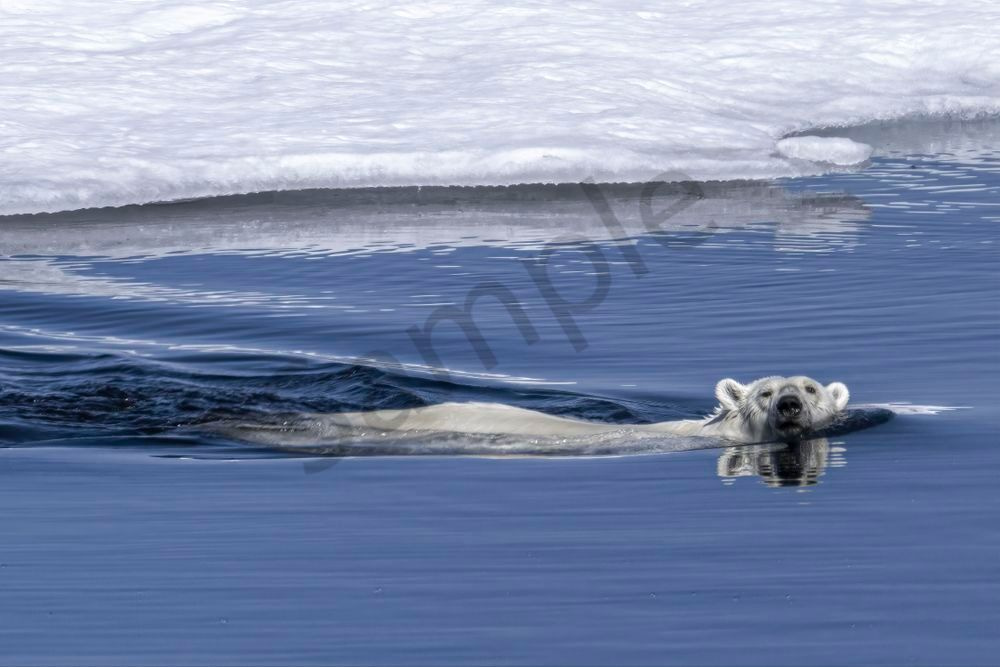
Swimming is the polar bear's ordinary commute, not an emergency. They are classified as marine mammals for good reason: the front legs do the work while the hind legs trail as rudders, and a bear will cross open water between floes without much apparent thought about it. What has changed is the distance. As the pack breaks up earlier and reforms later, the gaps between usable platforms widen, and a routine crossing becomes an endurance event.
From water level the animal almost disappears. All you see is the head, the wake, and a suggestion of mass underneath, which is a fair representation of how much of a polar bear's life happens out of sight.
The Arctic's food web is thinner than a temperate one and more tightly coupled: ice supports algae, algae support the invertebrates, those feed the fish, the fish feed the seals, and the seals feed the bear. Remove the ice and you do not lose one layer, you lose the scaffolding the rest is built on. That is why sea-ice extent, rather than bear counts, is the number scientists watch.
Inuit communities have been reading this system for millennia, and Arctic research now increasingly runs through programs built on that knowledge: SmartICE, for one, pairs community ice observations with sensors to map safe travel routes.
On printing this one: the water carries the image, the wake, the ripple pattern, the refraction where the body goes under. That is fine, high-frequency detail, and it is the first thing to disappear on a soft surface. Metal, or a metallic paper if you want less reflectivity.