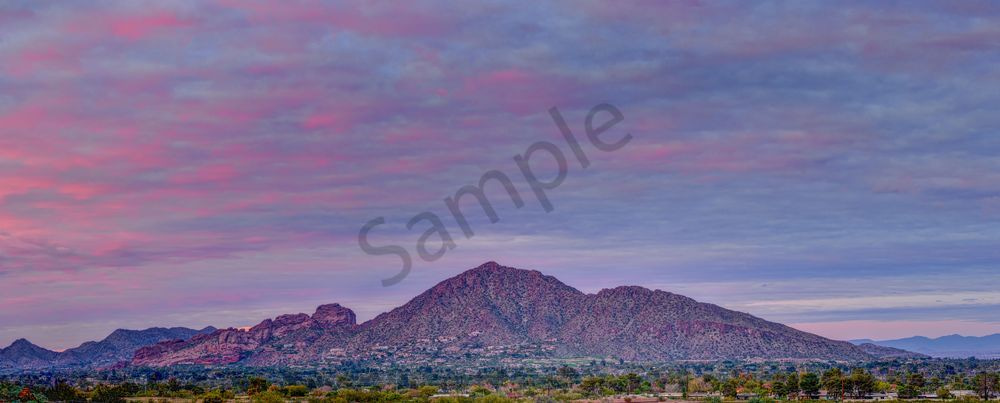
People assume the colour in this one has been pushed. It has not, and the reason it looks invented is that blue hour is genuinely lit differently from every other time of day.
Once the sun is below the horizon, nothing on the ground is receiving direct light any more. The mountain is lit only by the dome of the sky above it, which is blue, so the rock goes cool, blue-violet, holding almost no warmth at all. The high cloud, however, is still catching direct sunlight from below the horizon, and that light has travelled far enough through the atmosphere to have lost most of its blue. What reaches the cloud is red and magenta.
So you get two light sources of wildly different colour in the same frame at the same moment: warm magenta above, cold violet below, with no overlap between them. That separation is what the eye reads as unreal. It is also why the window is so short. A few more minutes and the cloud loses its light too, and the whole scene collapses into a uniform blue-grey.
Of the six evenings this is the one where the mountain matters least. The rock is almost a silhouette, present mainly to anchor the bottom of the frame and give the colour something solid to sit against. The photograph is about the sky, and the mountain is the reason the sky has a scale.