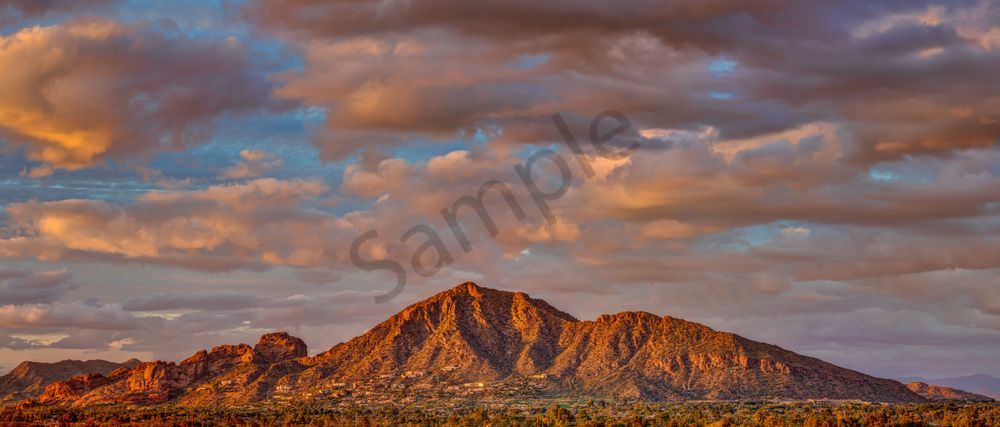
This is a winter photograph, and it could not have been made in summer. Not because of the weather, but because of where the sun sets. In summer it drops too far to the south to rake across the face of Camelback, so the light arrives closer to head-on and the mountain flattens out. In January and February the sun sets far enough round that the light comes in from the side, and side light is what builds the rock: every ravine casts, every ridge gets an edge, and the mountain reads as a solid object instead of a brown shape.
The same low winter angle does something to the houses on the lower slopes. It catches their windows and flares them, so the hillside picks up pinpoints of light you simply do not get at any other time of year.
Winter also buys clean air. Summer at this location is too hazy for a long lens. Haze accumulates across every mile between the camera and the subject, and at this distance it drains contrast and colour out of the rock before the file ever reaches the computer. Cold, dry winter air is what lets the colour in this frame be as saturated as it is.
What the side light reveals is that Camelback is not one mountain but two, separated by an almost absurd amount of time. The long hump is Precambrian granite, roughly 1.5 billion years old, formed as magma that cooled slowly deep in the early crust and then stayed buried for most of its existence. It only reached daylight about 25 million years ago, when tectonic stretching tilted whole fault blocks up out of the valley floor. It is hard, grey, and it keeps its shadows.
The head at the western end is barely a heartbeat old by comparison. When those granite blocks shifted, the new slopes collapsed in violent landslides, and the debris, granite rubble in deep red sand and gravel, compacted into the red beds now called the Camels Head Formation. Around 25 million years old, softer and redder, and it takes low sun and amplifies it.
Which means the line where the red rock meets the grey is a gap of nearly 1.5 billion years of missing record, wider than the Great Unconformity in the Grand Canyon. In flat midday light the two halves read as one brown mountain. In winter side light they separate, and you can see the join.