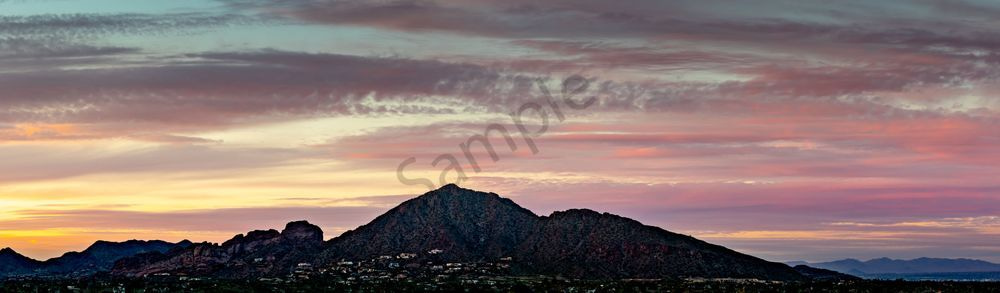
The mountain is named for what this photograph shows and the others do not. Strip away colour, texture and the detail of the rock, leave only the outline against a lit sky, and the resemblance that gave Camelback its name becomes the whole subject: a resting animal, head lowered at one end, the long rise of the back beside it.
You lose that in good light. When the sun is on the rock, the eye goes to the cliffs, the ravines, the houses tucked into the lower slopes, the colour of the stone. All of it is interesting and all of it competes. In silhouette there is nothing to look at but the line, and the line is the thing people recognise from across the valley.
Technically this is the hardest of the six to expose. The sky is several stops brighter than the land, and the temptation is to lift the shadows and recover the mountain. I did not. The dark mass is meant to be dark, and the only real decision was where to let the black go completely and where to keep just enough separation between the ridge and the sky behind it.
The gold still burning at the left edge is the sun's last direct light on the horizon. It sets the clock on the whole frame: a few minutes earlier the mountain would have had detail, a few minutes later the sky would have gone flat.