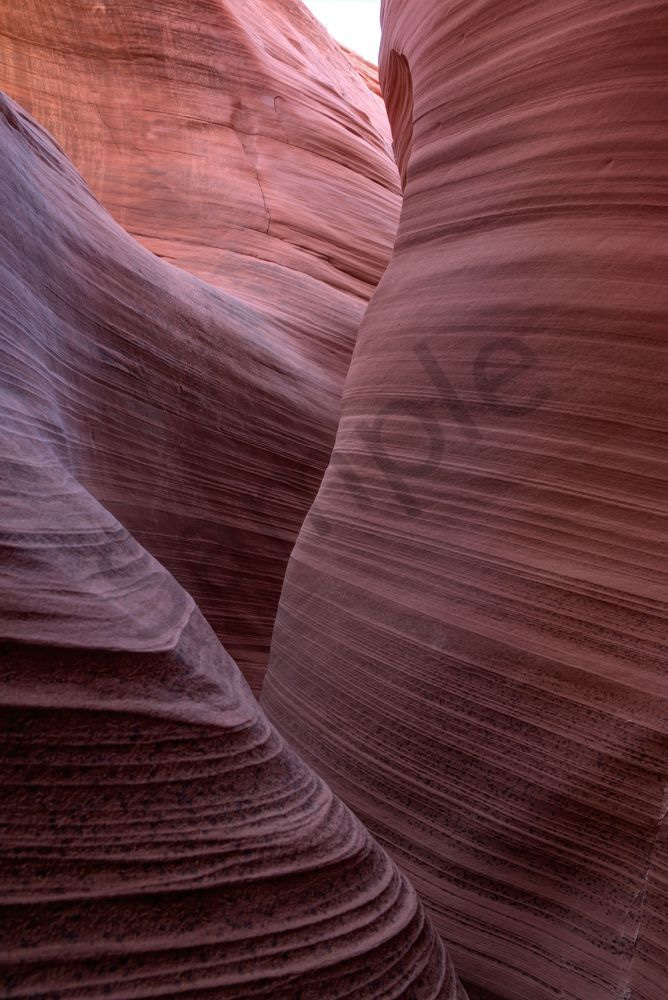
Everything you are looking at was cut by water that was not here for very long.
A slot canyon is not carved by a river. It is carved by flash floods: rain falling miles away on slickrock that absorbs almost nothing, gathering into a channel, and arriving as a wall of water carrying sand. The sand is the tool. Water alone would take an eternity to work sandstone, but water loaded with abrasive grit behaves like a belt sander running at the speed of a freight train, and it cuts downward far faster than it cuts sideways. That is why the passage is so much taller than it is wide.
The vertical fluting on these walls is the record of it. Each groove marks where the flow concentrated and dug, flood after flood, over a span of time nobody can date precisely because every flood erases part of the evidence of the last one.
This frame is the coolest in colour of the set, and deliberately so. There is no shaft of sun reaching the walls here, so the rock is lit only by daylight filtering down from the opening far above, which arrives blue. Most slot canyon photographs chase the orange glow. This one is what the place looks like for the majority of the day, and the mauve and lavender in it are not a processing decision.