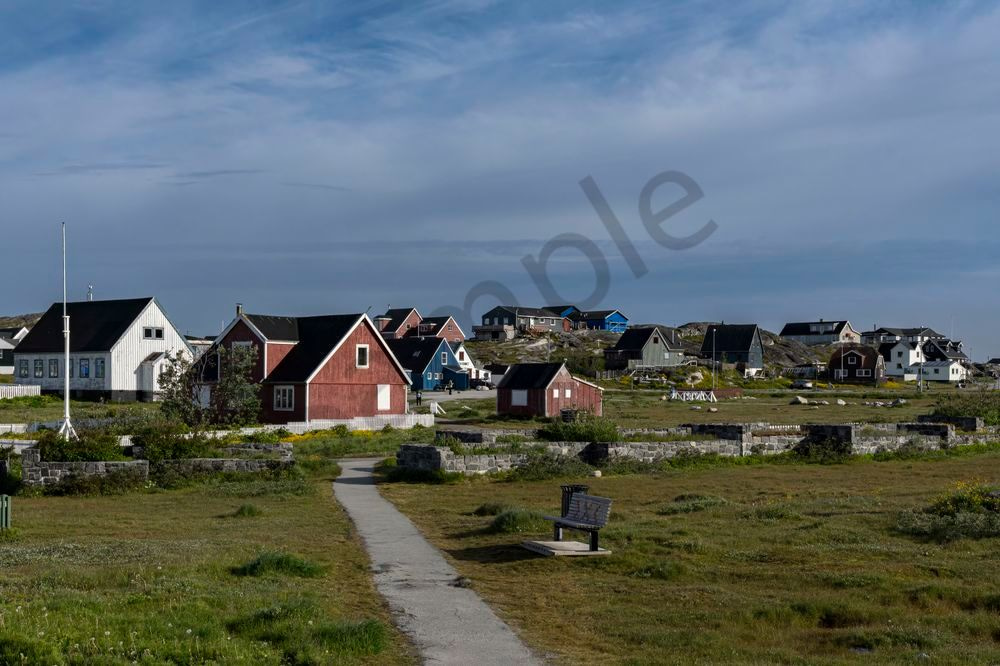
Nuuk holds about 20,000 people, more than a third of Greenland's entire population, and is by a wide margin the country's political, economic and cultural centre. It has the parliament, the country's only university, the new international airstrip, and an ongoing construction boom. It is also, five minutes outside town, this.
That abruptness is the thing I wanted to record. There is no suburb, no gradual thinning out. The built edge of the capital stops and the country resumes. It is a useful corrective to the idea of Greenland as uniformly empty: the population is intensely concentrated, and the emptiness around it is correspondingly complete.
Colonisation here began in 1721, when the Lutheran missionary Hans Egede arrived in this area: the founding event of Danish Greenland, and a complicated one to commemorate. His monument stands above the old harbour under an inscription thanking him on behalf of "the people of Our Land." Home rule came in 1979, self-rule in 2008, and the question of full independence is live in a way that would have been unimaginable a generation ago.
Fun fact: tourism to Nuuk changed sharply after 2019, when international attention arrived from an unexpected direction. Locals will tell you, with a certain dryness, that the publicity was not unwelcome even if the proposal was.
On printing this one: Arctic greens are subtler than temperate ones and sit in a narrow band, so this image lives or dies on colour accuracy rather than punch. Metal or metallic paper both hold it well. Avoid anything that pushes saturation. It turns the tundra artificial immediately.