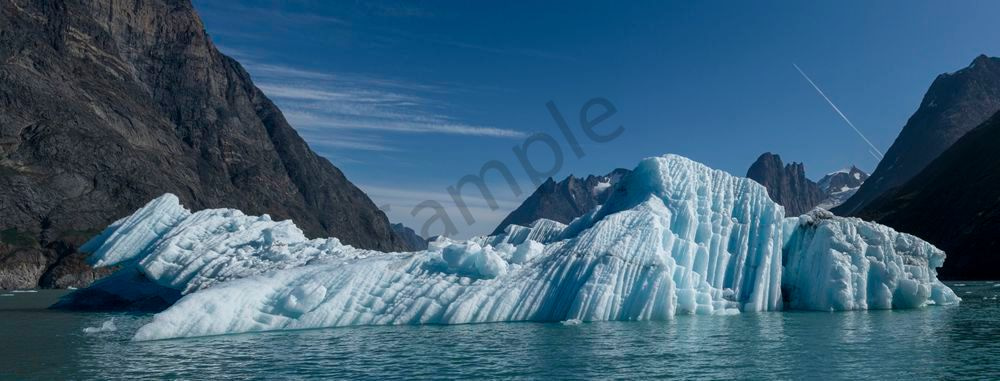
Iceberg ice is not frozen seawater and it does not behave like the ice in your freezer. It is compressed snow, hundreds or thousands of years of it, squeezed until the air bubbles are driven out and the crystal structure grows large. That is why the densest, oldest ice reads blue: with the bubbles gone, the ice absorbs the red end of the spectrum and returns the blue. The whiter, chalkier parts of a berg are younger, more aerated ice.
Look for dirt. Many bergs carry bands of rock flour, gravel and sometimes substantial stones, picked up where the glacier scraped along bedrock, possibly hundreds of kilometres inland. When the berg finally melts, that material drops to the sea floor wherever it happens to be: a mechanism that has been redistributing Greenland's geology across the North Atlantic for as long as there has been an ice sheet.
The shapes come from repeated capsizing. As a berg melts unevenly it becomes unstable, rolls, and presents a new face to the air: often a face that was scoured smooth underwater. The sculptural quality people respond to in these photographs is the record of that process. No two are alike because no two have taken the same route to get here.
On printing this one: the blues are the reason to own it, and they are the thing most likely to be lost. Dense old ice reads as a deep, slightly unreal cyan that matte paper renders politely and metal renders honestly. This is a metal image.