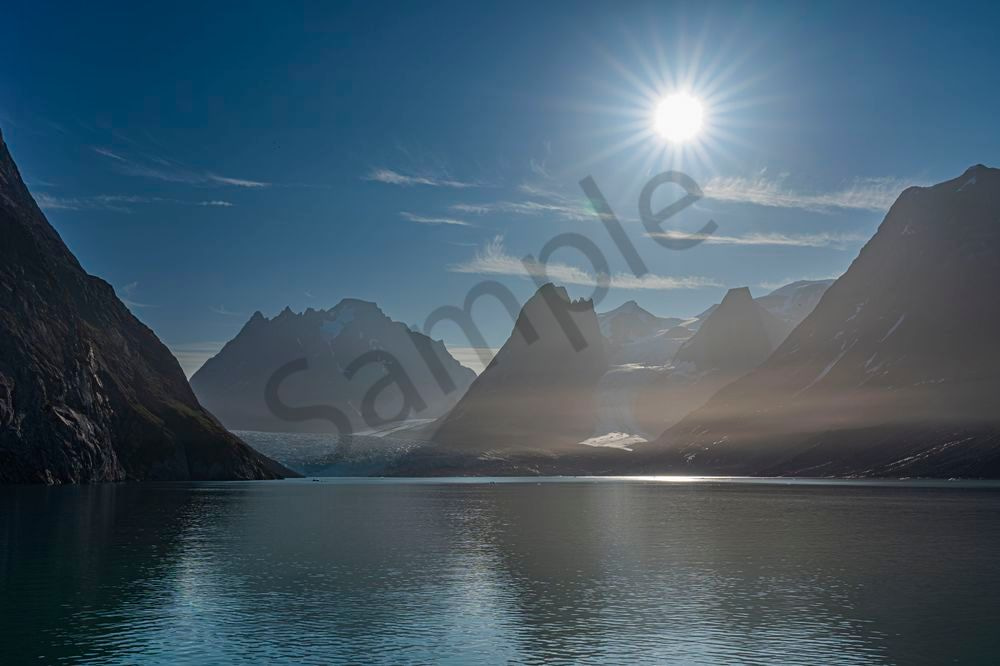
Kangerlussuaqsiaq is the kind of place that recalibrates your sense of scale. The fjord walls run for miles, the glacier at its head is still actively shaping the valley, and there is no object anywhere in the view, no tree, no building, no boat, to tell your eye how big any of it is. Photographs of Greenland fjords consistently look smaller than the reality because the brain has nothing to measure against.
Greenland is the world's largest island, with a total population of roughly 57,000 people, nearly sixty percent of them concentrated in the four largest towns. Which means that landscapes like this one are not remote from anywhere. They are simply the country. Between the settlements there is essentially nothing but rock, ice and water, and it goes on at this pitch for two thousand kilometres.
Something worth knowing about the ground in the foreground of images like this: land ownership is not permitted in Greenland. People own their houses, but not the ground underneath them. The land is treated as a shared resource rather than a commodity, which is an Inuit idea that survived colonisation and is now written into how the country works.
Fun fact: the name contains the Greenlandic root kangerluk, meaning fjord, the same root in Kangerlussuaq, the town at the head of a different and much longer fjord where our charter flight from Toronto landed.
On printing this one: the whole point of the image is that nothing in it gives you scale, and a small print defeats that. This is a wall piece. Printed at real size, standing close, you get the disorientation I was after; printed small it is just a nice view of a fjord.