There is a reason the icebergs pile up here rather than dispersing, and it is hidden under the water. When Sermeq Kujalleq was larger it pushed a moraine ahead of itself, a bulldozed berm of rock and debris, and as sea levels rose that moraine was submerged, leaving a shallow sill across the mouth of the ice fjord.
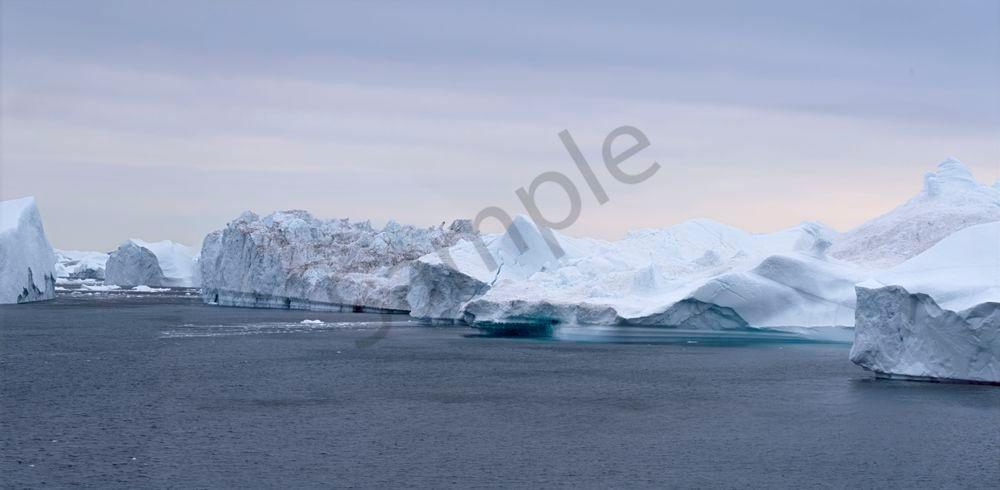
Icebergs calve at the glacier front and drift down the fjord, but since roughly ninety percent of each berg is underwater, the big ones reach the sill and ground out. They cannot get over it. So they jam, exactly like a log jam in a river, and the fjord behind fills with stranded ice roughly ten kilometres from end to end. Nothing moves until a berg melts enough to float free or breaks up under the pressure of the ones behind it.
That is what you are looking at: not a drifting field of ice but a queue. The bergs at the seaward end have been waiting, sometimes for a long time, and will leave in an order decided by their draught rather than their arrival.
Our expedition leader's description of the scale stayed with me. He told us plainly that it was on a scale he could not convey to us in a briefing room, and he was right.
On printing this one: this is a wide scene made of hundreds of individual bergs, and at small sizes they merge into a white band. It needs width. Printed large, you can pick out individual pieces of ice and the jam reads as the queue it actually is.