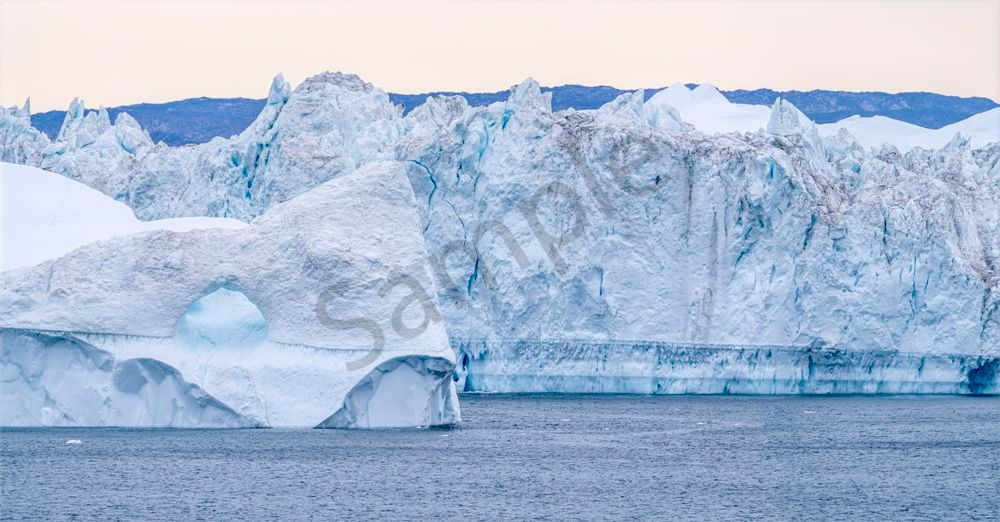
A single berg, isolated from the jam, and a chance to talk about what one of these actually is rather than what the whole fjord looks like.
Start with age. The ice at the bottom of the Greenland sheet fell as snow tens of thousands of years ago and has been under increasing pressure ever since, which drives out the trapped air and grows the ice crystals large. Some crystals in deep glacial ice reach the size of a fist. That is the ice that reads deep blue and rings rather than crunches.
Then size. The bergs coming out of this fjord are among the largest in the Northern Hemisphere; the tall ones stand a hundred metres above the waterline, which, at roughly a nine-to-one ratio below the surface, implies something approaching a kilometre of ice from top to keel on the biggest examples. Those are the ones that ground out on the sill and stay.
And then fate. Every one of them is going to the North Atlantic to melt, releasing its freshwater and dropping its cargo of ground-up Greenland onto the sea floor. The entire spectacle is a delivery system. Beautiful, and entirely transitional.
On printing this one: a single berg against open water is a portrait, and it hangs like one. It wants to be alone on a wall rather than part of a grouping. Metal suits the ice. If you prefer paper, pearl carries the translucency better than matte does.