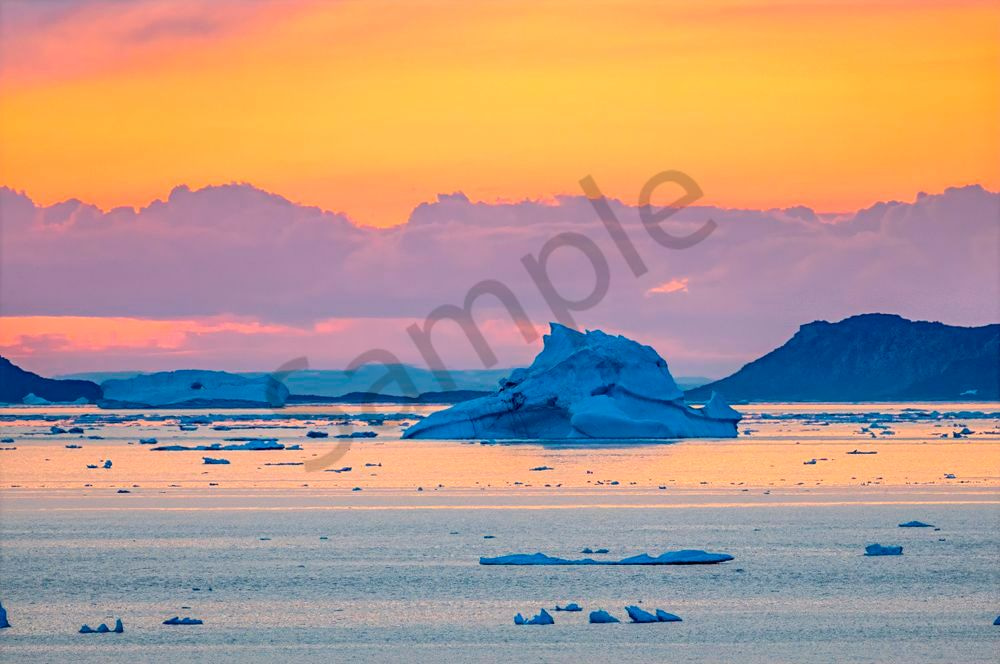
The voyage was called Circling the Midnight Sun, and the name is literal. At these latitudes in August the sun does not properly set. It slides along near the horizon for hours, then comes back up without the sky ever reaching full darkness. The practical consequence for a photographer is extraordinary: the golden hour becomes a golden half-night. Light that would last twenty minutes at home holds its angle and quality for hours.
The cost is that you stop sleeping. There is always something happening in that light, and you can always justify staying up for it. Several of the images in this gallery exist because nobody on board had a sensible relationship with bedtime by the second week.
What the low sun does to ice is the reason to stay up. Struck from the side, a berg's faces separate into distinct planes of warm and cool: the lit surfaces going gold and amber, the shadowed ice staying blue, because shadowed snow and ice are lit by the sky rather than the sun. That colour separation is real and not a processing decision; it is simply what happens when you have two light sources of very different colour temperature and a subject made of translucent material.
On printing this one: the warm-cool split, gold on the lit faces, blue in the shadowed ice, is the entire image, and it is a colour relationship rather than a detail. Pearl paper renders it beautifully and metal renders it dramatically. Either is right; it depends on the room.