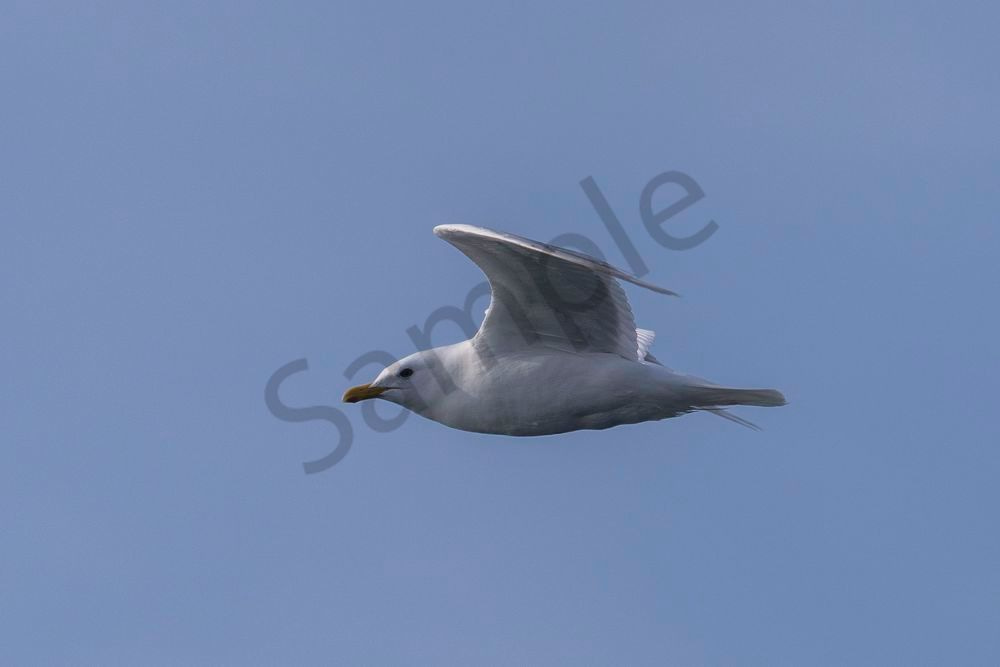
The Arctic supports more than 200 bird species, and the overwhelming majority are here only for the brief summer. The Glaucous Gull is one of the few large birds that genuinely belongs to the high Arctic year-round, and the region's food web is why: an opportunist that will take eggs, chicks, fish, carrion and whatever a polar bear leaves behind can make a living here when a specialist cannot.
It is the second largest gull in the world, and the field mark is the absence of something. Nearly every large gull shows black in the wingtips; this one shows none at all. The primaries are white, the mantle is pale grey, and against dark Arctic water the whole bird looks bleached: almost luminous. Once you have that in your eye, a Glaucous Gull is unmistakable at distance even when size is hard to judge.
Note the spelling, because it trips people up constantly: Glaucous, from the Latin for a pale bluish-grey, describing the mantle. Not "Glaucus", which is a Greek sea god, and not to be confused with the Glaucous-winged Gull: a Pacific Northwest bird that does not occur in the Arctic at all.
On printing this one: this bird is nearly all white, and white subjects need a surface that can distinguish highlight from paper base. Pearl fine art paper does this well, which is why I suggest it for the gull images generally. A narrow mat and a black or white frame keeps the attention where it belongs.