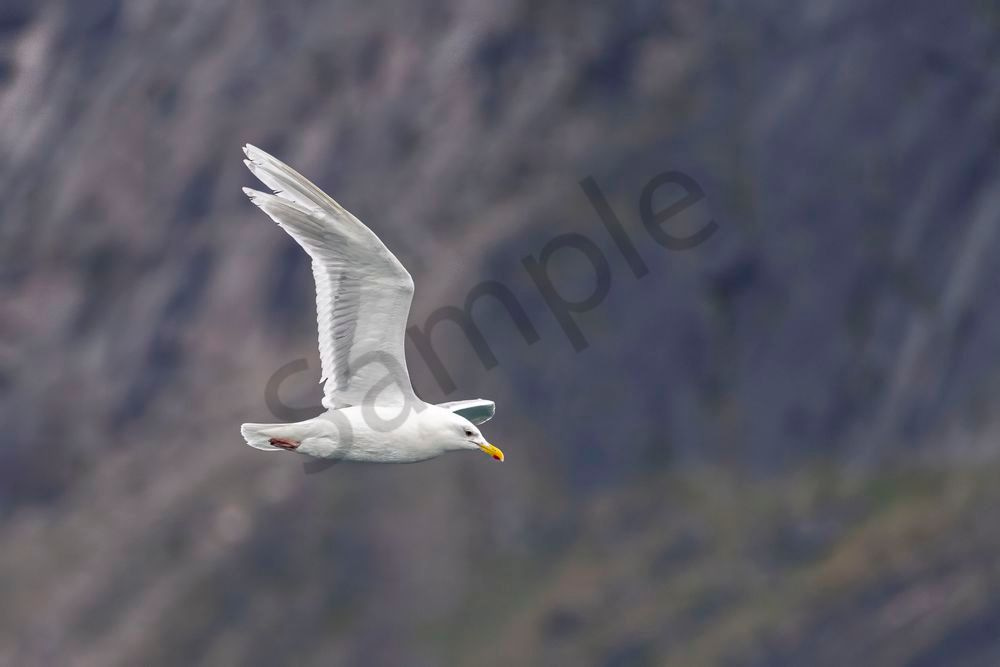
Flight is where the lack of black wingtips does its most striking work. Backlit, a Glaucous Gull's primaries glow, there is no dark pigment to stop the light, and the bird reads as a pale cutout against whatever is behind it. Photographically that is both a gift and a trap: the exposure latitude is unforgiving, and it is very easy to blow the wingtips to blank white and lose the feather structure entirely.
Structurally this is a heavy gull, and it flies like one: slower, more deliberate wingbeats than the smaller gulls, with a noticeably deep chest and a heavy bill carried level. Size in isolation is nearly impossible to judge at sea, but the cadence of the wingbeat is a reliable clue once you have watched a few.
They are long-distance migrants. Birds that breed in the high Arctic winter across the North Atlantic and North Pacific, reaching the British Isles, the northern United States and the Great Lakes, which means a gull photographed off Baffin Island in August may be squabbling over a Michigan parking lot by January. The Arctic is much less far away than it feels.
On printing this one: backlit white primaries are the hardest thing in this entire gallery to reproduce. There is real feather structure in those wingtips and it sits within a whisker of pure white. Pearl or metallic paper holds it; standard matte tends to flatten it to blank. If you go paper, order the mat and frame with it rather than framing later.