Seabirds follow ships, and there is nothing sentimental about it. A moving hull turns over water, disorients small fish and invertebrates near the surface, and pushes up a wake that concentrates food, so a gull that attaches itself to a vessel is working a productive patch that moves for free. Fulmars do the same thing. For days at a time we had an escort.
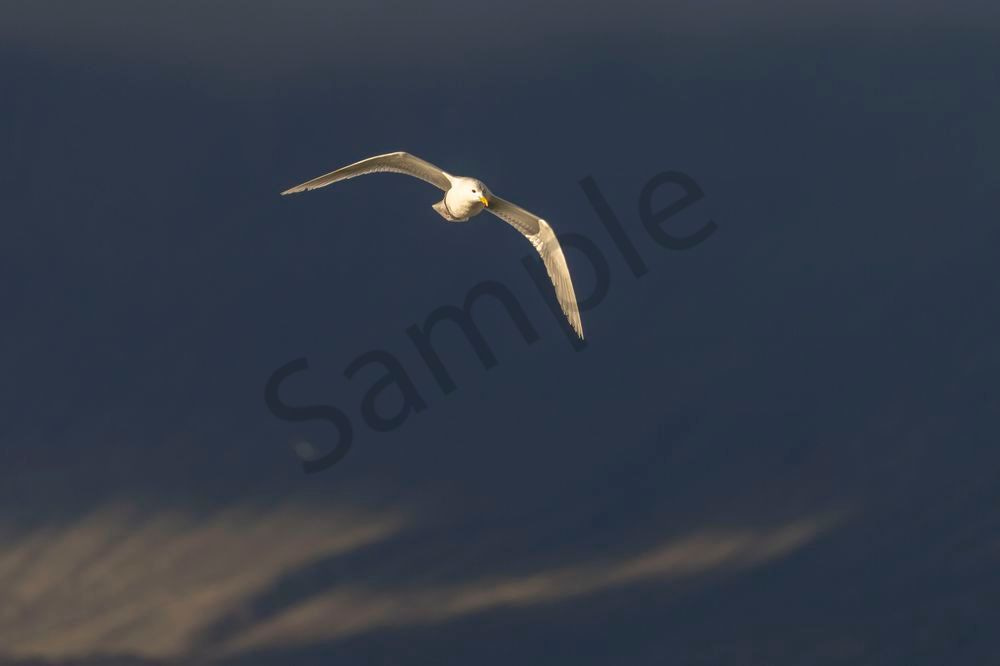
That is why so many of these frames exist. Gulls in normal circumstances will not tolerate a close approach; a gull that has decided your ship is a food source will fly alongside the rail at arm's length for an hour, matching speed, holding position in the airflow, and occasionally looking directly at you. It is the best photographic access to a wild bird most people will ever get.
Notice how little it is doing. In the right position relative to the ship's airflow the bird can hold station almost without beating its wings: the same energy economy the fulmars practise on ocean swells, applied to a manmade updraught. Every large bird in the Arctic is running a tight energy budget, and the ones that thrive here are the ones that have found ways to let something else do the work.
On printing this one: the gull images work as a group. Two or three of them together, printed at the same size on the same paper and framed identically, make a far stronger wall than any one of them alone. Pearl fine art paper with a narrow mat is what I would choose, and ordering the framing with the print avoids the much higher cost of custom framing afterward.