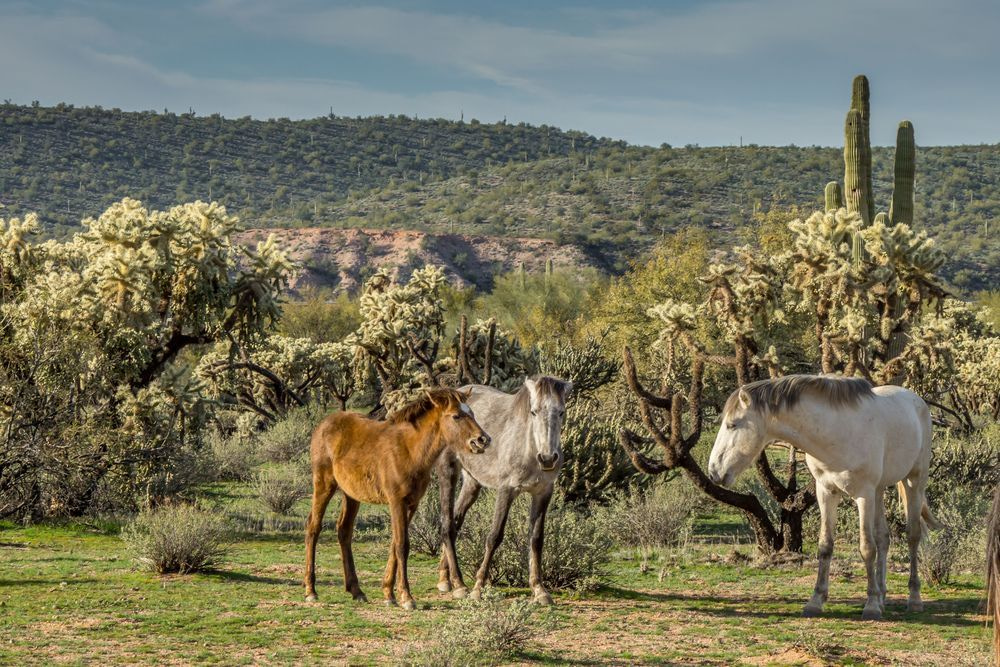
What you're seeing is three bands in one place, which is less common than it looks and more interesting than it appears.
Salt River horses live in bands, typically one stallion, a handful of mares, and their foals, and bands are stable over years, not seasons. Horses know each other. When two bands share ground, they don't merge; they hold a soft distance and keep track. Young stallions without mares form bachelor groups and circle the edges of all of this, waiting.
So a "gathering" is really several families tolerating proximity while every adult present keeps a continuous tally of where everyone else is. The conversation the horses appear to be having in this frame is closer to negotiation. And it resolves the way you describe in the product copy: one newcomer got too familiar with another stallion's mare and was removed from the situation, along with his entire band.
The cholla matters too. This is a cholla forest, and cholla is not ordinary cactus: the segments detach at a touch and the barbed spines will go through a leather boot. Horses move through it with complete confidence and people do not. Any photograph made in cholla involves someone choosing their footing very carefully, at a distance, with a long lens, and accepting that they cannot simply reposition.
On printing this one: a multi-horse frame needs size in a way a single portrait doesn't, at small dimensions the individuals merge into a brown mass and the spacing between bands, which is the actual subject, disappears. This wants to be the largest print in a wild horse grouping, with the single portraits hung smaller around it.